VIDEOS

Want to run the BEST meetings? (it takes less than 1 minute to learn...) #business
Episode 35 answers the listener question, "How can I make my meetings run better?"
Check out my show Ask Christa! where I review listener questions, answer with practical tips that work, then support more learning with additional resources in the show notes!
---------------------
Ask Christa! Business Questions, Straight Answers, Real Impact
© 2025 Christa Dhimo in partnership with Impono LLC and 21st Century Strategies. Ask Christa! has a pending T…

The best presentations focus on the audience #business #professionaldevelopment #presentationskills
Check out Episode 36 that answers the listener question, "How can I improve my presentation skills?"
(most think it's about slide design, Canva automation, or "telling a story...")
Nope. Just one thing: obsess about audience experience.
Check out my show Ask Christa! where I review listener questions, answer with practical tips that work, then support more learning with additional resources in the show notes!
---------------------

Ask Christa! How can I improve my presentation skills? S3E36
Summary
In this episode, Christa Dhimo addresses a listener's question about improving presentation skills as a way to advance their career. Christa emphasizes the importance of connection with the audience, every-day practice, rigorous preparation, and finding one’s unique style. She discusses the complexities of communication, the typical pressures of presenting, strategies for designing and conducting effective presentations. The episode concludes with resources for further develo…

Be that person at work who runs the best meetings!!! #business #businesstips
Episode 35 answers the listener question, "How can I make my meetings run better?"
Check out my show Ask Christa! where I review listener questions, answer with practical tips that work, then support more learning with additional resources in the show notes!
---------------------
Ask Christa! Business Questions, Straight Answers, Real Impact
© 2025 Christa Dhimo in partnership with Impono LLC and 21st Century Strategies. Ask Christa! has a pending T…

Want to improve your meetings? Start with a philosophy that it's not your meeting... #business
Painful. Boring. Disruptive. Agonizing.
These are typical descriptions of what meetings are like. But it doesn't have to be that way...
Check out Episode 35 that answers the listener question, "How can I run my meetings better? "
And check out my show Ask Christa! where I review listener questions, answer with practical tips that work, then support more learning with additional resources in the show notes!
---------------------
Ask Chr…

If you think your meeting is for your benefit, think again... #business #worktips #leadership
Episode 35 answers the listener question, "How can I make my meetings run better?"
Check out my show Ask Christa! where I review listener questions, answer with practical tips that work, then support more learning with additional resources in the show notes!
---------------------
Ask Christa! Business Questions, Straight Answers, Real Impact
© 2025 Christa Dhimo in partnership with Impono LLC and 21st Century Strategies. Ask Christa! has a pending T…

How Ask Christa! helps you!!! #business #learning #selfimprovement #career #personalgrowth
Check out my show Ask Christa! where I review listener questions, answer with practical tips that work, then support more learning with additional resources in the show notes!
The latest episode answers the listener question, "What do executives do?" (and it's not a sarcastic question-- it's an honest question, and it makes sense that many folks may not know....)
---------------------
Ask Christa! Business Questions, Straight Answers, Real Impact <…

Business isn't Finance. Finance is important, but there's more to running a business #business
Episode 33 answers the listener question, "How much finance should I [a founder] learn?"
And check out my show Ask Christa! where I review listener questions, answer with practical tips that work, then support more learning with additional resources in the show notes!
---------------------
Ask Christa! Business Questions, Straight Answers, Real Impact
© 2025 Christa Dhimo in partnership with Impono LLC and 21st Century Strategies. Ask Christa! has …

Ask Christa! How can I run my meetings better?
Summary
In this episode, Christa Dhimo addresses the common challenges of effective meeting management, emphasizing the importance of preparation, understanding the purpose of meetings, and fostering a culture of respect—especially a respect for time. She provides practical tips for structuring effective meetings, ensuring they serve the team's needs rather than the meeting owner's needs. She also discusses the cultural implications of frequent, unproductive meetings and offers …

Effective executives enable success (with no drama...) #business #executive #success
We hear about the greed, the dysfunction, the chaos... people hear "executive" and have all kinds of opinions because of what they see on social media and hear on the news and see/hear on TV. But the greatest ones, and there are a lot out there, take their leadership roles seriously. We don't hear about them because it's boring. They aren't as greedy, they take care of employees, and they remove obstacles so others can be successful.
Yup. Boring.
But …

Business isn't just finance-- business is a team sport... #business #businessgrowth
Episode 33 answers the listener question, "How much finance should I [a founder] learn?"
And check out my show Ask Christa! where I review listener questions, answer with practical tips that work, then support more learning with additional resources in the show notes!
---------------------
Ask Christa! Business Questions, Straight Answers, Real Impact
© 2025 Christa Dhimo in partnership with Impono LLC and 21st Century Strategies. Ask Christa! has …

Executives have to think about efficiency-- but not the "efficiency" most have heard of #efficiency
The "efficiency" everyone has heard of over the last several months (and even the last many years) has twisted what "efficiency" is really about: a strategy to create room so employees can focus on what really matters within the time they are paid to work.
And check out my show Ask Christa! where I review listener questions, answer with practical tips that work, then support more learning with additional resources in the show notes!
---------------------

A Board of Directors MUST remain independent to be effective... #business #leadership
Different boards of directors require different closeness to the organization. Some BoDs need to be more involved than others, and some are part of what it takes to raise money and funds (like the BoD of a nonprofit).
But generally speaking, the most functional and highest functioning BoD (with the best perspective to offer the best service to an organization) maintains independence-- this is particularly true in for-profit organizations.
If a Board Member is too close to the…

Ask Christa! What do executives do? #business #career #careerdevelopment #businesseducation
Summary
In this episode of Ask Christa, Christa Dhimo addresses a listener's question about the role of executives in any size organization. She explores the fundamental responsibilities of executives, emphasizing the importance of accountability, communication, decision-making, performance, and efficiency. She also reviews the traits that make effective leaders, especially executives, and talks about the significance of executives enabling strategy execution. Christa also highlights…

What's the Executive Role about?? #business #leadership #executive
Check out Episode 34 of Season 3 that answers the listener question, "What do executives do? "
It's not a sarcastic question, so put the chip away... in today's world where we hear SO MUCH GARBAGE and RANTS and COMPLAINTS about executives (and in those cases, it's often for good reason), there are thousands of executives doing their jobs well, with people at the forefront of how they lead. We just don't hear about them...
(because no one wants to…

Finance is but one aspect of a business #building #smallbusiness #businessgrowth
Episode 33 answers the listener question, "How much finance should I [a founder] learn?"
As a founder, an essential component to your and your business's success is how much business (overall) you should learn: business is a system of various functions, all with responsibilities to enable success.
And check out my show Ask Christa! where I review listener questions, answer with practical tips that work, then support more learning with additional resources in t…

The MOST CRITICAL experience of a Board Member? PROPER CRISIS MANAGEMENT... #business #leadership
It's a myth that all members of a Board of Directors are experts-- or even have the right experience for their role. But you need at least 30% of your Board with experience in properly and constructively handling and leading an organization through a crisis (which means, they don't panic, seek blame, and create chaos...) (yeah, I know... I know... that's what most do... I've seen it...)
Episode 32 answers the listener question, "What do Boards of Directors D…

Being a founder is more than the idea... #business #smallbusiness #strategy
Check out Episode 31 that answers the listener question, "What aspects of a business do founders overlook the most?"
Some think being a founder is about having the big ideas; nope-- it's much harder than that, and the best do it while knowing the baseline needs of supply and demand...
And check out my show Ask Christa! where I review listener questions, answer using practical tips, then offer additional resources (always in the show notes)!
------------…

Biz performance goes beyond finance... #business #smallbusiness #leadership
Episode 33 answers the listener question, "How much finance should I [a founder] learn?"
(as much as what will make you effective!!)
Business performance goes beyond finance, and while finance is a critical function, you could say the same about ALL functions at different times in a business's lifecycle.
And check out my show Ask Christa! where I review listener questions, answer with practical tips that work, then support more learning with additional…

Ask Christa! How much finance should I learn?
Summary
In this episode of Ask Christa, host Christa Dhimo addresses a listener's question about how much finance knowledge and learning a founder needs as they get a business started. She emphasizes that while finance is crucial, it is not the sole focus of a business. Christa discusses the various functions within a business, particularly the role of General and Administration (G&A), and how they support overall operations (and how Finance is a part of G&A). She encourages …
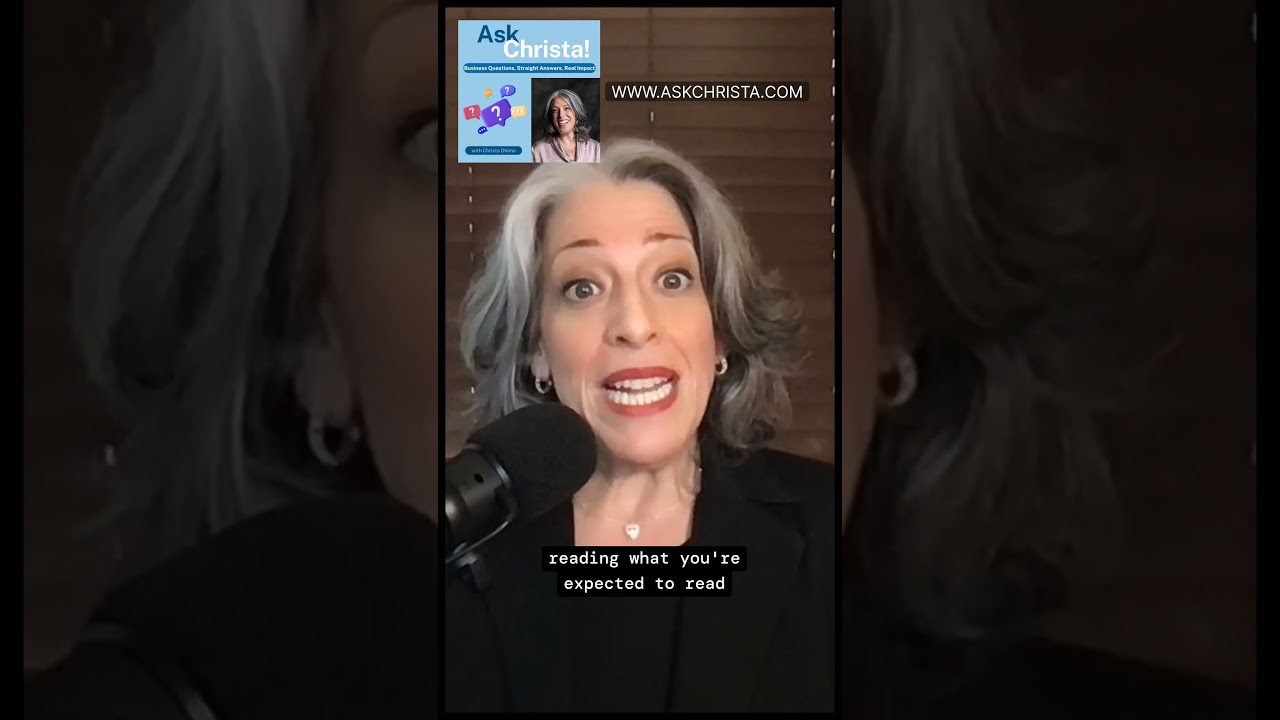
A Board of Directors provide leadership and MUST have impeccable traits... #business #leadership
In Episode 32, I answer the listener question, "What Do Boards of Directors Do? " (if I were to be cheeky, my first answer would be, "at times, cause a lot of problems...")
Your BoD requires experience and expertise that's best for your organization at any given time in its development or contraction-- but the MOST important aspects of your Board is related to the traits of your Directors... they are in SERVICE to your organization...
And check out my…

Founder Leadership Means Rolling Up Your Sleeves! #business #leadership #smallbusiness
I've know quite a few founders who talk about themselves as "visionaries" while struggling to get the difficult, dirty work done: being able to put a business together to actually make the vision happen.
Check out Episode 31 that answers the listener question, "What aspects of a business do founders overlook the most? "
And check out my show Ask Christa! where I review listener questions, answer using practical tips, then offer additional resources (…

The Founder's Role Isn't Just About Vision (you need a plan, too) #business #startup #smallbusiness
Check out Episode 31 that answers the listener question, "What part of a business does a founder overlook the most?"
Startup fail because they run out of money, can't raise more money, have a hard time launching a product, timing, market-fit... but there's also (and often) a pronounced lack of planning.
You don't need a deeply detailed plan, but having a business plan at startup with placeholders for what you'll learn as you gain speed brings a…

Outsourcing lets a business do what they do best #smallbusiness #business #efficiency
Episode 30 addresses the listener question, "What is outsourcing and should all businesses do it?" (and yes, all businesses should do it, especially the smaller ones...) -- the biggest reason? It enables a business to focus on what they do best. "3PLs," or third party logistics companies, are a great example of this. If you are a jewelry maker, why would you want to build a warehouse, buy software, and manage an enormous inventory and logistics function if you can hire a…